Demographics: The brand’s core consumers are young children, historically marketed primarily to boys ages 3 to 8 (TheCaseSolutions.com, n.d.). This audience is global, with Hot Wheels sold in over 150 countries (Mattel, 2023).
Psychographics & Attitudes: This audience consists of imaginative “thrill-seekers” drawn to speed, competition, and the kinetic joy of racing and crashing cars. They embody a “challenger” mindset. This is supported by Mattel’s research, which found that children who frequently play with Hot Wheels are 32% more likely to be eager to take on new challenges and persist through failure (Nasdaq/Business Wire, 2024).
Behavioral Traits: Play is hands-on, active, and creative. Children in this group enjoy collecting and trading, racing with friends, and constructing elaborate tracks. The low price point (around $1 for a basic car) encourages frequent purchases, often at the request of the child, leading to large personal collections.
Social Media & Media Consumption: While not active on traditional social media, this group are heavy consumers of digital content. They are primarily found on YouTube and YouTube Kids, where they watch official animated series (like Hot Wheels City), user-generated stop-motion races, and countless unboxing videos that fuel their desire to play and collect (Future Social, n.d.).
Secondary Audience: Adult Collectors (“Kidults”)
Demographics: This significant and growing segment is typically composed of males ranging from their late teens up to their 60s, with a common profile being a man in his 30s or 40s with disposable income (TheCaseSolutions.com, n.d.). The “kidult” market (adults buying toys for themselves) is the fastest-growing demographic for the toy industry as of 2025 (Nguyen, 2025).
Psychographics & Attitudes: This audience is driven by three primary motivators: nostalgia, a genuine passion for authentic car culture, and the “thrill of the hunt” (DrivingLine, n.d.). Collecting provides a strong emotional connection to their childhood and a sense of belonging to a larger community.
Behavioral Traits: Adult collectors engage in the hobby seriously, investing significant time and money. They actively “hunt” at retail stores for new releases and rare “Treasure Hunt” models, attend swap meets, and purchase premium, adult-focused collectible lines. This dedication is reflected in sales; Mattel’s adult-oriented product lines have seen sales triple since 2017 (Nguyen, 2025).
Social Media & Community Engagement: This audience is highly active and organized online. They form massive, vibrant communities in Facebook groups and on Instagram, where they share photos of their finds, discuss upcoming releases, and trade cars. They also follow the official Hot Wheels social accounts, which cater to them with behind-the-scenes design content and lifestyle-oriented posts (Future Social, n.d.).
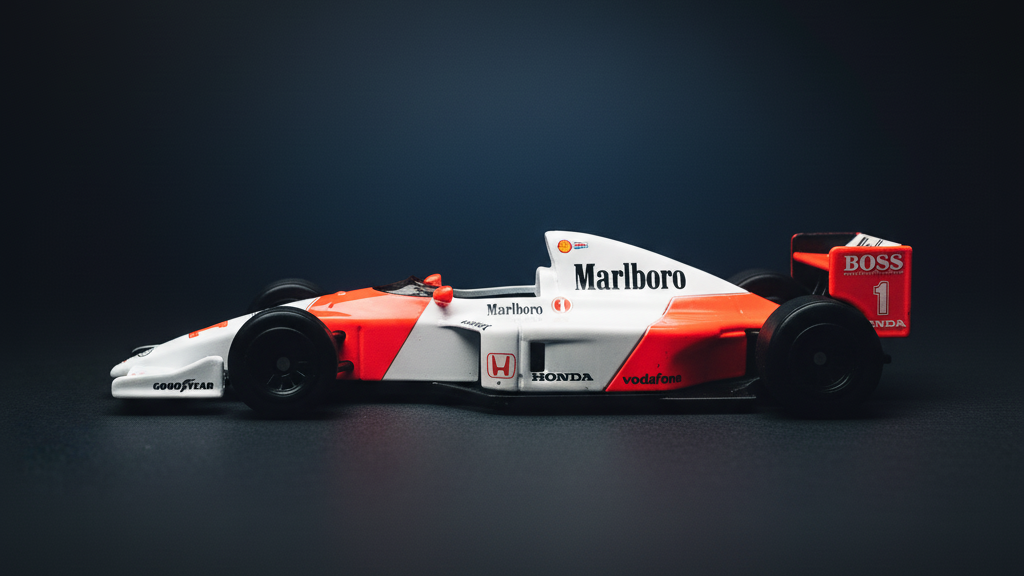
“Hot Wheels x Aryton Senna, studio shot, dark background”, Google Gemini, Nov.1.
2. Three Central Storytelling Themes
“Challenge Accepted”: This is Hot Wheels’ core narrative. It positions every child as a brave challenger and frames play as a fun, low-stakes way to test limits, persist through failure, and grow. The message is that challenges are opportunities, not obstacles.
Fueling Imagination and Creativity: This theme centers on the brand as a catalyst for open-ended, creative play. With fantastical designs and flexible track systems that pushes DIY gameplay experience, Hot Wheels tells kids there is no wrong way to play.
Nostalgia, Community, and Cross-Generational Connection: This theme leverages the brand’s 55+ year history to build an emotional bridge, primarily with adults. It tells the story of a shared passion passed down from parent to child, and it celebrates the vibrant global community of fans who never really outgrow the hobby.
3. Analysis of Storytelling Resonance
The Challenger Spirit theme resonates powerfully with children’s intrinsic love of competition and achievement. It also appeals directly to parents (specifically Millennial parents) who seek “purposeful play” and want to see their children develop resilience and a growth mindset (Nasdaq/Business Wire, 2024; Helixa, 2018).
The Imagination/Creativity theme speaks to a child’s desire for autonomy and imaginative freedom. It also reassures parents that the toy is developmental and encourages creative problem-solving rather than passive entertainment (Helixa, 2018).
The Nostalgia/Community theme is squarely aimed at adultcollectors and parents. For collectors, it validates their hobby and connects them to a shared passion. For parents, it provides a powerful nostalgic link to their own childhood, making them more inclined to purchase the brand for their kids and share the experience (Schreiber, 2022).
Potential Research Methods
Survey Research and Focus Groups: To gather quantitative and qualitative data from parents and children, such as the research conducted with Mindset Works for the “Challenge Accepted” campaign (Nasdaq/Business Wire, 2024).
Social Listening: Actively monitoring fan forums, Facebook groups, and Instagram to understand the language, motivations, and desires of the adult collector community in real-time.
Sales and Market Trend Analysis: Tracking sales data (e.g., the tripling sales of adult lines) to validate the growth of a segment and justify investing in content (like the Legends Tour) that targets it (Nguyen, 2025).
“Hot Wheels style Monaco Grand Prix Track”, Google Gemini, Nov.1.
4. Three Questions for Further Exploration
How does Hot Wheels measure the direct impact of its storytelling campaigns (like “Challenge Accepted”) on specific business outcomes, such as brand loyalty metrics or sales for featured products?
In what specific ways is Hot Wheels adapting its brand story and product design to more intentionally broaden its audience, particularly in appealing to girls and in new international markets with different local car cultures?
As digital play becomes more prevalent, how will Hot Wheels extend its core “challenger spirit” and “creative play” narratives into virtual spaces (like the metaverse or new video games), and how will the traditional, hands-on collector audience respond to this shift?